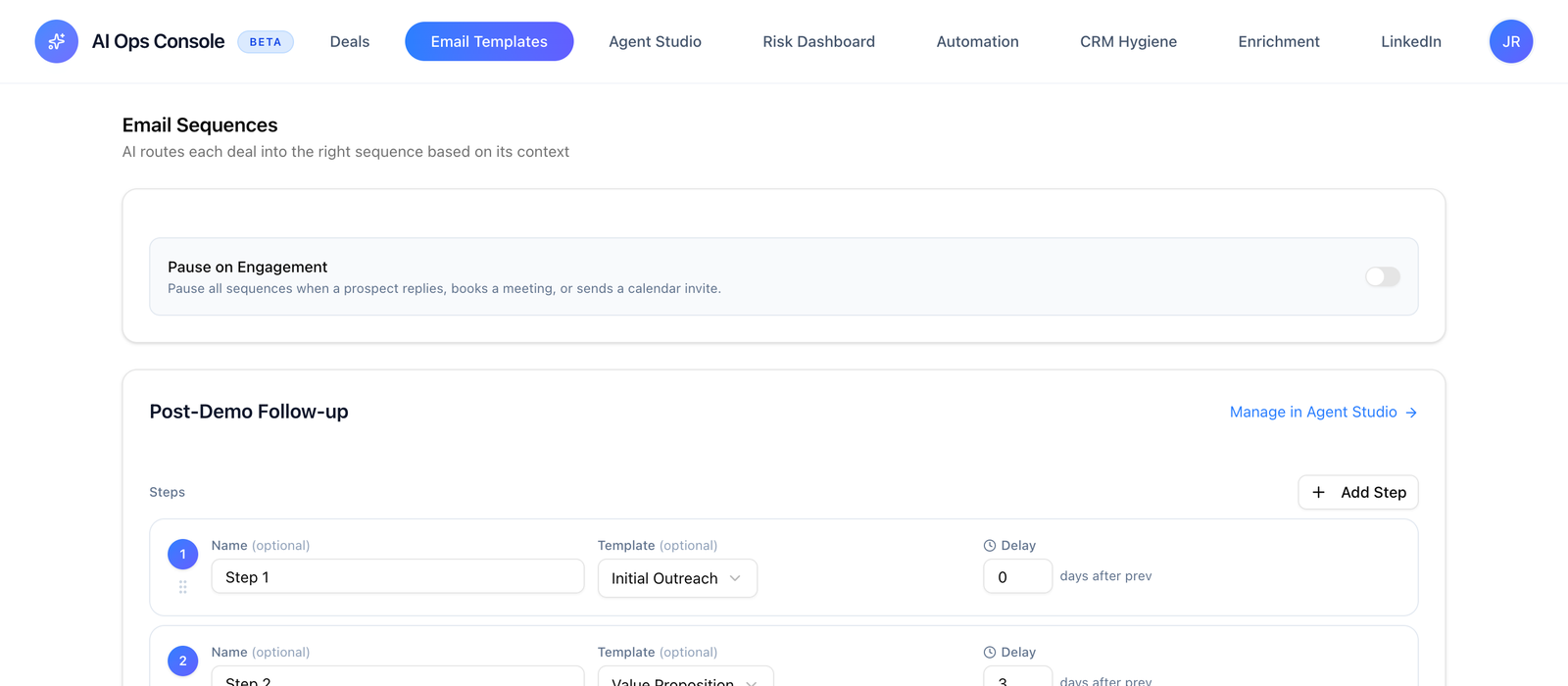
Multi-step cadences, configured per deal or per organisation, with timing and conditions that respond to what’s actually happening in the conversation.
Scope
Per-deal + org-wide
Steps
Unlimited
Conditioning
On reply, stage, risk
Templates
Versioned, variable-substituted
Most sequence tools run a fixed playbook regardless of what happens in the deal. They send step three on day five whether or not the prospect replied to step two with a critical objection. CHRM’s sequences are aware of the deal.
Every step can condition on what CHRM knows: did the prospect reply, was a risk introduced, did the stage advance. Sequences pause when a real conversation is in flight and resume when it isn’t.
Two scopes.
Build org-wide sequences for SDR-style cadences your whole team uses. Build deal-level sequences for active opportunities where the cadence is specific to that customer’s journey. Both share the same template library and the same variable substitution.
Variables that pull live deal context.
Template variables substitute from live deal data: deal name, company, named stakeholders, the next agreed step, the last meeting’s summary. Templates are versioned and can be drafted, reviewed, and published like any other content.
Per-deal sequencesBuild a cadence specific to an active opportunity. Adjust it as the deal evolves.
Organisation-wide sequencesShared SDR/AE cadences across the team, with pause settings centrally managed.
Conditional stepsStep timing and content can respond to reply, stage change, or new risk.
Versioned templatesDraft, review, publish. Variables substitute from live deal data.
CHRMSequence editor · 6 steps · 12 active deals
Conditional steps that respond to what the deal does.
CHRM is the execution layer for CRM. After every sales conversation — a call, a demo, an email thread — CHRM fills your CRM fields, generates a personalised follow-up, and flags any deal risks. It sits between your conversations and your CRM. Your closers never log a field. Leadership always has accurate pipeline data.
OAuth, fifteen minutes. You connect your CRM, define which fields CHRM should populate, and link your AI note-taker. From that point every processed conversation flows directly into your CRM. No middleware, no manual steps. No credentials stored on our side.
CHRM currently supports HubSpot and Pipedrive. If Salesforce is your system of record, mention it on the intro call and we'll tell you honestly whether we can support your setup today.
No. CHRM works alongside your existing note-taker. They handle recording and transcription. CHRM takes the transcript and acts on it. If you don't use a note-taker, CHRM can process email threads and manually uploaded notes. Capture and execution are different jobs.
Most teams are fully configured and processing their first calls within one business day. Three steps: connect your CRM, define your field mappings, link your note-taker. We run a 30-minute configuration session with every new team so it works correctly for your exact setup from day one.
Gong and Clari are conversation intelligence. They tell you what's happening in your deals. CHRM acts on it. CHRM doesn't surface insight for humans to act on; it takes the action automatically. Gong is analysis. CHRM is execution. They solve different problems.
Completely. You define the exact fields you want CHRM to populate — custom fields, standard fields, deal stages, contact properties, anything in your HubSpot or Pipedrive. Most teams configure ten to twenty fields per deal record. We don't impose a template.
92–97% field accuracy on well-structured calls. Accuracy depends on conversation quality — calls where deal specifics are explicitly discussed produce near-perfect outputs. When information is ambiguous or not discussed, CHRM leaves the field empty rather than guess.
Five categories: missing decision-maker, budget uncertainty, competitive threat, timeline drift, and champion disengagement. Risk flags are surfaced inside your CRM, not buried in a call recording somewhere.
CHRM processes transcript data to extract structured deal fields and does not store raw conversation audio or video. Transcripts are processed then discarded. Only the extracted structured fields are written to your CRM. We integrate with your CRM and note-taker via OAuth; no credentials are stored on our servers.
Not yet. We're early, and a formal SOC 2 audit is ahead of us, not behind us. What's true today: CHRM connects to your CRM and note-taker over OAuth, stores no credentials, and discards transcripts once the structured fields are extracted. If your security team needs a formal review, ask on the intro call and we'll walk through exactly how we handle data.
$1,000 per AE seat per month. Every other seat — managers, RevOps, leadership — is free. The first thirty days are free for up to five AE seats. We don't do self-serve trials because a 15-minute configuration session is what makes CHRM work correctly from day one.
B2B sales teams with 5–50 account executives. At that scale CRM hygiene is a constant operational problem: large enough to matter for forecasting, small enough that you're not running a dedicated RevOps engineering team. Teams under 5 reps often find the admin manageable. Teams over 50 typically need enterprise CRM architecture we don't currently serve.
Book a call
Stay human. Let AI do the rest.
A twenty-minute call. Then a configured product, the same week. We don’t do self-serve onboarding. A short call lets us configure CHRM to your CRM fields, your deal stages, and the way your team actually works. If we’re not the right fit, we’ll say so before the second call.